
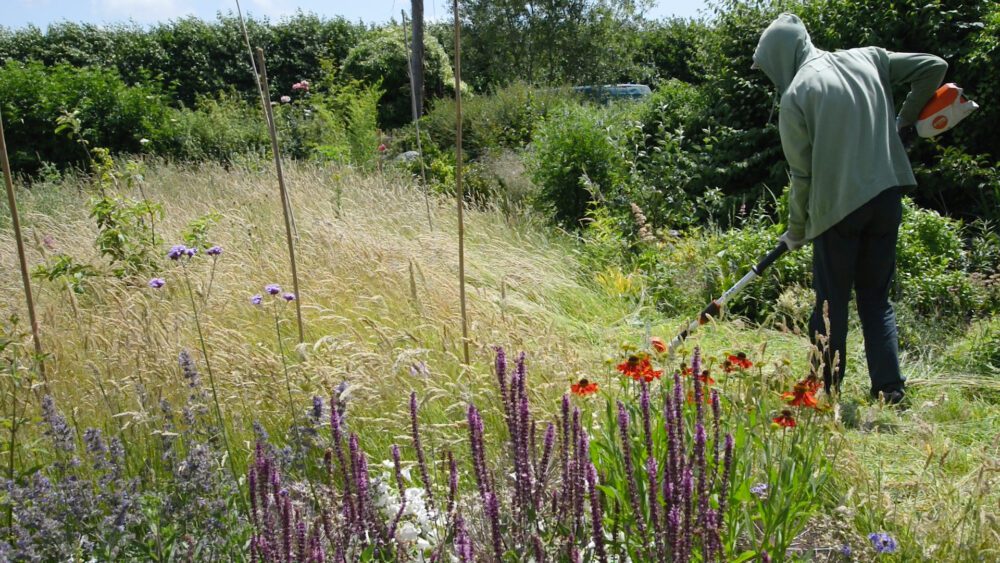
Is June too early for cutting down a meadow? The answer is… it depends on what you’re trying to achieve. For most meadows, it’s too early. The wildflowers won’t have set seed yet. And what if you have ground-nesting birds?
But if you’re trying to remove as much nutrition from the soil as possible, enabling the wildflowers to compete with the grasses, June could be the perfect time.
Watch the video and read on for more details:
Why do we need to remove nutrients from the soil to encourage wildflowers?
It comes down to grasses versus wildflowers. Both are important parts of a healthy meadow ecosystem. But if the soil is too nutritious, the grasses will outcompete the wildflowers that we’re trying to encourage.
A meadow on former agricultural land, which has historically been highly fertilised, is not likely to have very many wildflowers. The same is true of meadows on naturally rich soil or in gardens that have had lots of fertiliser or manure applied.
Although these soils can still produce valuable meadows, increasing floral biodiversity can be more challenging.
How to remove nutrients from your garden soil?
So long as we remove the grass clippings… whenever we mow a lawn or meadow, we are removing nutrients. We take those nutrients and organic material, and we put them on our compost pile.
A great use of grass clippings!
To maximise the effectiveness of this clipping removal, we can time the procedure to perfection. By late June, the grass plants have reached their maximum above-ground biomass. The grass hasn’t started returning nutrients to its root system, so now is the time to cut and remove clippings.
For optimum timing, aim to cut around the summer solstice.
Are there other ways to remove nutrition from a meadow?
Yes, there are, and I’m going to be demonstrating one method later this year. That is sowing a parasitic wildflower plant called Yellow Rattle (Rhinanthus minor).
Technically, this doesn’t remove nutrients from the soil at all, but it does control grass growth. What it does is reduce grass growth by parasitising it. It removes water from the grass roots, thereby reducing grass vigour.
I’ll explain this in more detail when I show you how to sow Yellow Rattle in autumn.
Are you cutting down a meadow this June?
As I’ve said, June isn’t always the best time to cut a meadow, but it can be. I’d love to know if you’re cutting down a meadow this June or if you’ll be waiting until July or August.
Let me know if the comments!
Happy gardening.
Joe
