
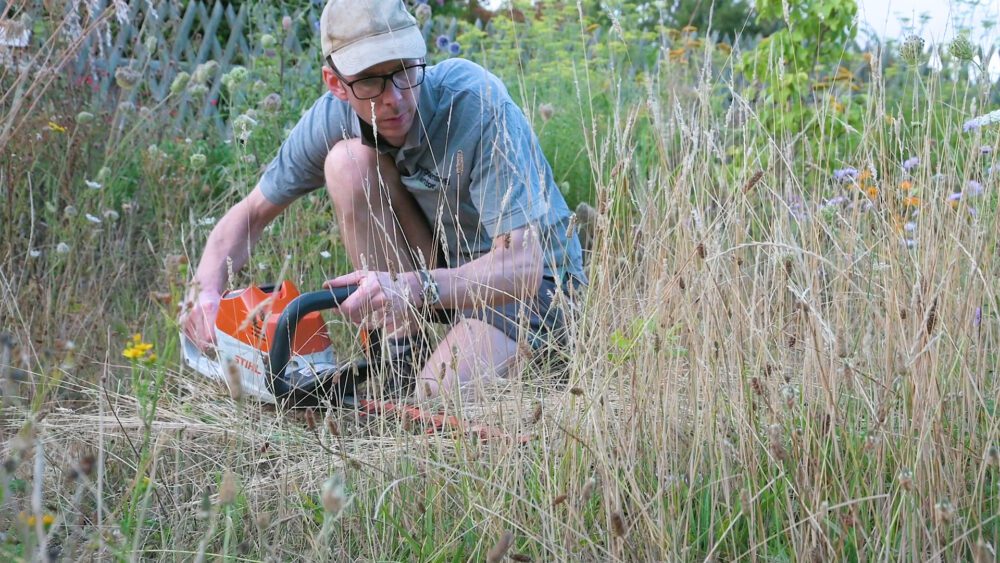
Your wildflower meadow has been the perfect home and food source for wildlife since early spring. If you want it to be the same (or even better) next year, now’s the time to cut it down.
Cutting your wildflower meadow to the ground may seem drastic. You may wonder why it can’t be left standing over winter. But cutting is essential for biodiversity in the long run.
Check out my video to see how I do it:
Watch the video and read on for more details:
Understanding your wildflower meadow
Alright, to understand why cutting wildflower meadows is so important for diversity, we need to understand the origin of meadows in Britain. So in as few words as possible…
- Britain (without human intervention) would be mostly woodland. Some was probably quite dense, some was more open with grass and wildflowers growing beneath. There would also have been much smaller areas of grassland (without trees) that supported many of the wildflowers that we know and love.
- Around 6,000 years ago, humans started clearing woodland to graze their livestock.
- The livestock grazed on grass, but also young tree saplings, which prevented woodland from re-forming.
- This enabled wildflowers to spread from existing grassland into this new “human-made” grassland.
- In medieval times, humans began harvesting hay in summer to feed their livestock in winter. This removed nutrients from the soil, which was good for the wildflowers as it allowed them to compete with the faster-growing grasses.
Many of our modern-day wildflower meadows have been maintained like this for hundreds of years, and floral biodiversity has continued to grow.
So is growing a meadow NOT re-wildling?
When we turn an area into a wildflower meadow, we’re not re-wildling. Unless we’re doing it in one of the few areas in the UK that has grassland as its climax vegetation.
However, wildflower meadows are an excellent habitat and food source for a huge range of wild flora and fauna. So by growing a meadow, you’re wilding. Just not re-wilding.
Meadows are also a lot easier to manage in our small home gardens than a woodland would be. Imagine telling your neighbours you were planting a forest in your garden.
Give the flowers some sunshine
One more thing. When we cut our meadow down in July or August, we allow sunlight to reach the crowns of our wildflowers. This enables them to put a good amount of growth on before winter, and get off to a strong start the following spring.
If we cut too late, this doesn’t happen, and we tend to see an overdominance of coarse grasses at the expense of floral diversity.
And if we don’t have floral diversity, we don’t have insect diversity. Less insect diversity means less bird diversity, fewer amphibians, fewer reptiles, fewer small mammals, and eventually fewer large predators.
You see, it all starts with the plants.
Do you have a wildflower meadow? Or do you want one?
If you have a wildflower meadow, I’d love to hear about it. When did you start it? Have you had any difficulties? Are you already seeing plant and animal diversity enjoying your meadow?
If you don’t have one, would you consider giving it a go? Go on, you’ll love it and so will the wildlife
Happy wildling.
Joe
