
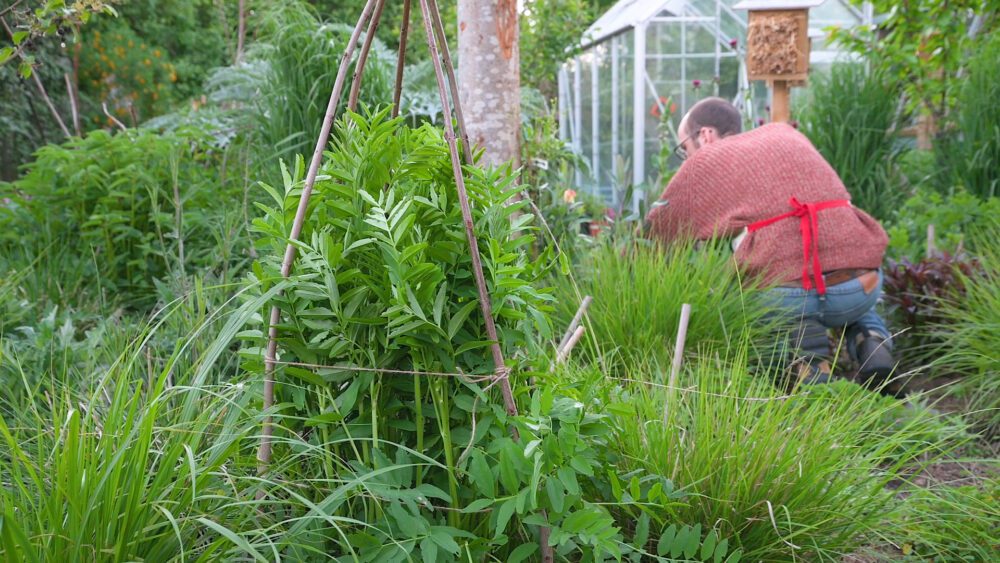
Most gardeners know that gardening is good for us.
We talk about gardening being therapeutic. We tell people to get outside and get some fresh air. And after an hour spent pottering around the garden, we usually feel better than we did before.
But why?
Well, there’s actually a growing body of research on gardening and wellbeing, providing evidence of how gardens and other green spaces can support both our physical and mental health.
And one explanation I find particularly interesting is that gardening brings together several essential human needs. I explore these in this video.
Watch the video and read on for more details:
What does the research tell us about gardening and wellbeing?
Research into the relationship between nature and wellbeing goes back decades.
In the 1970s and 80s, Rachel and Stephen Kaplan developed research around the idea that spending time in natural environments can help restore our ability to concentrate after mental fatigue.
Another well-known study looked at people recovering from gallbladder surgery. Patients whose hospital windows looked out onto trees recovered more quickly and required less pain medication than those looking at a brick wall.
Research since then has continued to explore the relationship between green space and our physical and mental health.
I’ve also seen some of this first-hand…
Over three years working in social and therapeutic gardening, I saw people respond to gardening in profound and unexpected ways.
- I witnessed how gardening and plants can trigger meaningful memories for people living with memory loss.
- Garden tasks like raking leaves could excite and enthuse people who usually showed little interest in activities.
- I saw shy people grow in confidence as gardening helped them to connect with others and with the natural world around them.
- I’ve seen what some people would describe as miracles: non-verbal people speaking, people with limited mobility achieving things they never thought possible.
So what is gardening giving us?
Five ingredients for wellbeing
Julia Hotz, an author and journalist specialising in social prescribing, identifies five ingredients shared by many activities associated with better wellbeing:
Movement. Nature. Art. Service. Belonging.
And gardening just so happens to bring all five of them together.
1) Movement
Gardening gets us moving.
We walk, dig, prune, lift, stretch, rake and carry things around. Sometimes, heavier things than we probably should.
And much of the time, we don’t necessarily think of it as exercise. We’re simply doing something that needs to be done.
Movement has been part of human life for as long as there have been humans. Our ancestors had to move to find food, collect water and access the resources they depended upon.
Our bodies are made to move. Gardening gives us plenty of opportunities to do that.
2) Nature
This is perhaps the most obvious one.
When we garden, we’re surrounded by plants, soil, wildlife, weather and the changing seasons.
For most of human history, nature wasn’t somewhere we visited when we had some spare time. It was where we lived.
Almost all of our existence as a species has unfolded within the natural world. So perhaps it shouldn’t be surprising that being surrounded by plants and other living things can feel familiar.
Gardening brings us back into direct contact with that world. It returns us to our ancestral home.
3) Art
Gardening is creative.
Every time we choose where a plant might grow, combine colours and forms, prune something into shape or decide how we want a space to feel, we’re making creative decisions.
When we sow seeds or propagate plants, we’re literally creating new life.
Creativity seems to be something that’s always been inside us.
Humans have been making art for an extraordinarily long time. Figurative cave paintings date back tens of thousands of years, with other forms of creative expression going back much further.
A garden gives us another canvas to work with, and another outlet for expressing our creativity.
4) Service
Gardening can also give us opportunities to do something for somebody, or something, other than ourselves.
We might grow food for our family. Help a neighbour care for their garden. Share plants. Create habitats for insects, birds and other wildlife.
Doing things for others feels good, which makes evolutionary sense. Humans have always depended upon cooperation. Caring, sharing resources and working together helped our ancestors survive.
Gardening offers us plenty of ways to contribute, including to species other than our own (check out the bee hotel in the video).
5) Belonging
Then there’s belonging.
Gardening has a habit of bringing people together.
We swap plants. Share knowledge. Ask questions. Tell stories. Give somebody far too many courgettes.
And those connections matter.
We’re a deeply social species. For much of human history, belonging to a group was fundamental to survival.
Gardening can give us ways to connect with other people around a shared interest, but it can also create another kind of belonging.
A sense that we’re part of the living world around us.
Perhaps gardening isn’t an escape
We sometimes talk about getting into the garden as a means of escape. And I understand why.
But I wonder whether the opposite might also be true.
Perhaps this connection between gardening and wellbeing isn’t to do with what it’s helping us to escape from. Maybe it’s more about what gardening bringing us back into contact with: things that have been fundamental to human life for an incredibly long time.
We move, create, contribute, spend time with other people, and we interact directly with the natural world.
Modern life can make it surprisingly easy to become disconnected from some of those things. Gardening puts them back together in one place.
Which might help to explain why something as simple as sowing seeds, pulling weeds or spending an afternoon outside can affect us in ways that seem much bigger than the task itself.
So next time you’ve spent some time gardening and notice that you feel a little different afterwards, have a think about why.
What were you doing?
Were you moving? Creating something? Helping wildlife? Talking to somebody? Or simply paying attention to the plants, weather and wildlife around you?
You might start noticing some patterns.
And perhaps understanding the relationship between gardening and wellbeing is another way of understanding why gardening matters.
How does gardening help your own wellbeing?
I’d love to hear about your experience. How has gardening helped your wellbeing?
Is there a particular gardening job that helps, time spent sharing the garden with someone else, or simply being outside and enjoying it? Let me know in the comments below.
And until next time. Happy, and healthy gardening.
Joe


